Will a 2 Ton Jack Lift a F150?
You are staring at a flat tire on your F-150. In the corner of the garage sits that little red jack you bought for your Honda Civic ten years ago. It says “2 Ton” on the peeling sticker. Your truck weighs less than 4 tons total. So, do you risk it?
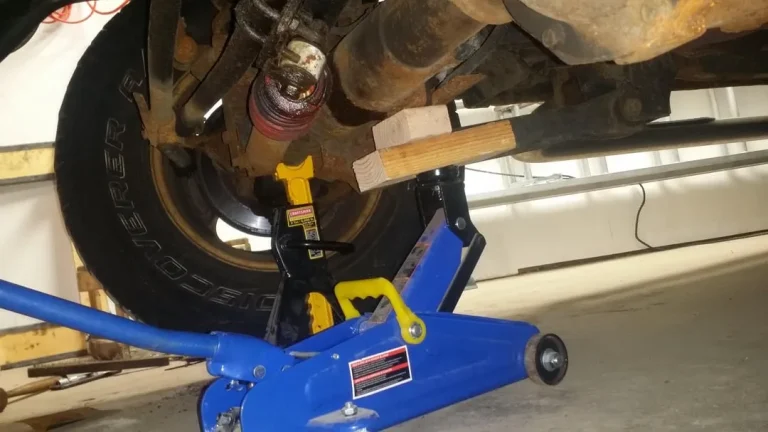
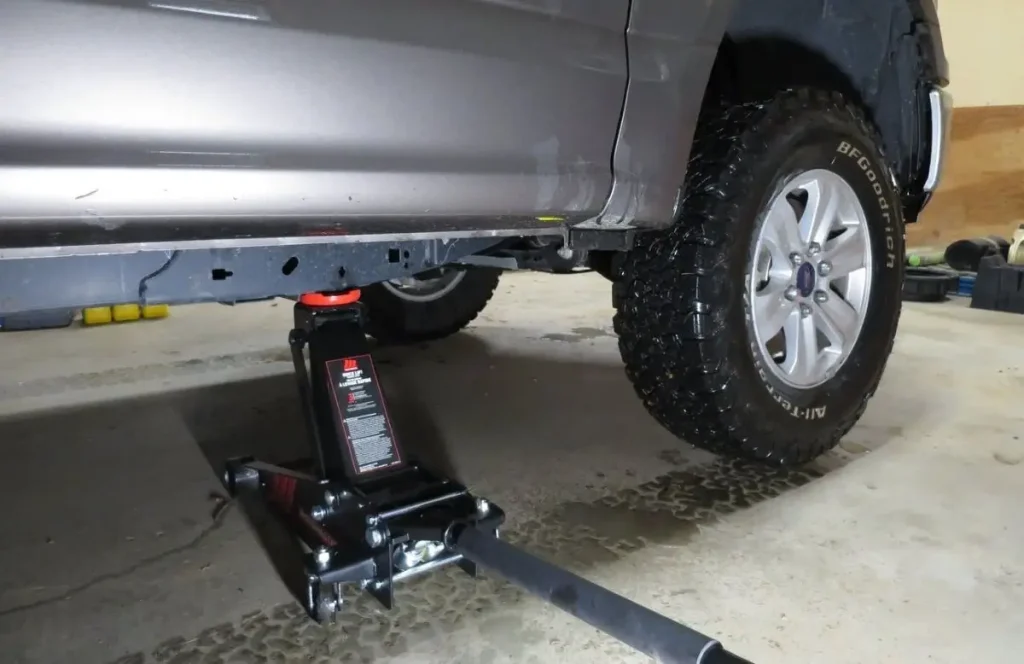
Will a 2 Ton Jack Lift a F150? The Short Answer: Yes, a 2-ton jack has the hydraulic strength to lift one corner of a Ford F-150, but it is dangerous due to severe instability. While the hydraulics can physically handle the Corner Weight, most 2-ton “trolley jacks” lack the wheelbase width and lift height required for a high-center-of-gravity truck. Using one creates a massive tipping hazard.
Why 2 Tons is Technically Enough
Let’s look at the cold, hard math. Mechanics love numbers because they don’t lie. Stickers on tools, however, often mislead you about real-world capability.
A “2 Ton” rating means the hydraulic ram is certified to lift 4,000 lbs.
Your buddy at the bar will tell you, “You can’t use that, your truck weighs 6,000 lbs!” He is wrong. Unless you are trying to bench press the entire truck from the center of the chassis (which is impossible), you are never lifting the full Gross Vehicle Weight Rating (GVWR) or even the full Curb Weight at once.
You are lifting one corner.
The Corner Weight Reality
On a standard pickup truck, the weight distribution is usually around 60/40. The engine makes the front heavy. If you have a 2020 Ford F-150 Lariat 4×4, the curb weight is roughly 5,200 lbs.
- Front Axle Weight: ~3,120 lbs.
- Rear Axle Weight: ~2,080 lbs.
- One Front Corner Weight: ~1,560 lbs.
Your 2-ton jack is rated for 4,000 lbs. Even if you are lifting the heavy front end of a fully loaded Platinum trim, you are asking the jack to lift less than 50% of its capacity. The Hydraulic Bypass Valve—the safety mechanism inside the pump that prevents overloading—won’t even blink.
Here is the breakdown of safety margins across different F-150 models.
F-150 vs. 2-Ton Jack
| F-150 Model / Trim | Approx Curb Weight | Approx Front Corner Load | 2-Ton Jack Capacity | Hydraulic Safety Margin |
|---|---|---|---|---|
| Base XL Reg Cab (2WD) | 4,050 lbs | ~1,250 lbs | 4,000 lbs | Safe (300%+) |
| Lariat Crew Cab (4WD) | 5,200 lbs | ~1,600 lbs | 4,000 lbs | Safe (250%) |
| F-150 Lightning (EV) | 6,800 lbs | ~2,100 lbs | 4,000 lbs | Acceptable (190%) |
| Loaded Work Truck (Bed Full) | 7,000+ lbs | ~2,200 lbs | 4,000 lbs | Acceptable (180%) |
Mathematically, you are fine. The piston will push. The arm will rise.
But then the truck will probably fall sideways.
The “Suicide Jack” Problem: Why You Should Still Say No
If the math works, why am I telling you to keep that little red jack in the corner?
Because hydraulics don’t kill mechanics. Lateral Instability kills mechanics.
Most 2-ton jacks sold at big box auto parts stores are Trolley Jacks. You know the type. It costs $40, it has a little plastic carry handle, and the steel frame is about as wide as a shoe.
The Geometry of Tipping
Think about the geometry here. An F-150 sits high. To get the tire off the ground, you need to lift the frame rail to about 20 inches (due to suspension droop).
A cheap trolley jack has a Footprint width of maybe 5 or 6 inches.
You are balancing 1,800 lbs of truck on a 6-inch wide base, extended 18 inches into the air. That is a recipe for disaster.
Floor jacks are designed to roll. As the arm goes up, the jack must pull itself forward under the load to keep the saddle centered. Cheap trolley jacks have terrible steel casters. They catch on pebbles. They dig into asphalt. They get stuck in expansion joints.
When the jack stops rolling but the arm keeps lifting, the load shifts. The Center of Gravity (CG) moves outside that tiny 6-inch base. The jack tips sideways. The truck comes down.
I have seen this happen. It happens fast. There is a metallic clunk, a scrape, and suddenly your rotor is buried in the driveway. If your legs were under there, they are gone.
Height Limitations: The Secondary Failure
Even if you balance the truck perfectly, you run into the “Short Jack” problem we discussed in our low-profile guide.
Most 2-ton jacks have a max lift height of 13 to 15 inches.
An F-150 frame sits 10 to 12 inches off the ground at ride height.
When you start pumping, the first 4 inches just touch the frame. The next 5 inches just stretch the suspension (droop). By the time you hit the mechanical stop at 13 inches of lift, your shock absorbers are fully extended, but the tire is still touching the concrete.
You physically cannot change the tire. This leads people to do stupid things, like putting the jack on top of bricks to get more height.
I once pulled up to a guy on the side of the highway trying to change a flat on a lifted Silverado. He had a 2-ton trolley jack balanced on a stack of paving stones. The stones were already cracking under the point load. I pulled out my 3-ton floor jack and saved him a trip to the hospital. Never extend a jack’s height with loose masonry.
The Lightning Factor: Electric Trucks Change the Rules
If you own an F-150 Lightning, the rules tighten up.
EVs are dense. The battery pack spans the entire floor. A Lightning weighs 1,500 lbs more than a standard gas truck. While our table shows the 2-ton jack still has the hydraulic power to lift it, the consequences of failure are higher.
The Lightning also has specific lift points to avoid crushing the battery casing. The saddle on a cheap 2-ton jack is usually a small steel cup with sharp teeth. This is brutal on aluminum chassis and pinch welds.
If that small cup slips or deforms the lift point on a heavy EV, you risk damaging the battery rails. That is a five-figure mistake caused by a $40 tool.
When IS a 2-Ton Jack Okay?
I am not saying all 2-ton jacks are trash. I am saying cheap trolley jacks are trash.
There is a massive difference between a “2-Ton Trolley Jack” and a “2-Ton Aluminum Racing Jack.”
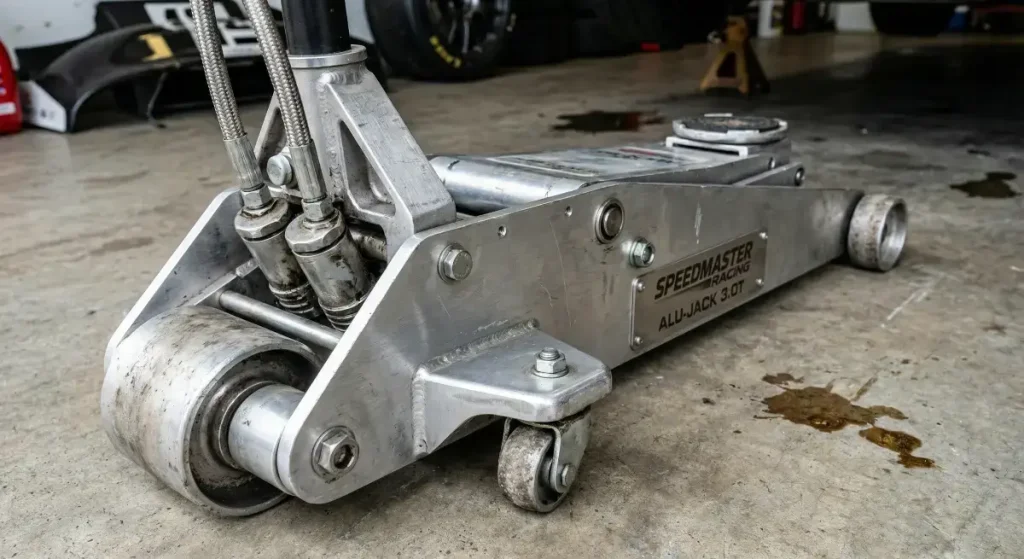
If you buy a high-end aluminum jack (like an Arcan or NOS), it is often rated at 2 or 2.5 tons. These are professional tools. They have:
- Dual Pistons (Fast lift).
- Wide Stance (10+ inches wide).
- Side Handles (For positioning).
If you have a quality Aluminum Racing Jack, you can safely use it on an F-150, provided it lifts high enough. The Working Load Limit (WLL) is honest, and the stability is there. The issue isn’t the “2 Ton” rating; it is the cheap construction associated with that rating.
Why 3-Ton is the Standard
If you are buying a jack for a truck, stop looking at the price tag and look at the steel. You want a 3-Ton Steel Floor Jack.
Why 3-ton? It’s not just for the extra 2,000 lbs of capacity.
- Size: 3-ton jacks are physically larger. They are longer and wider. This stability is what keeps you safe.
- Reach: They usually lift to 19 or 20 inches standard.
- Durability: The seals, the rams, and the casters are built for abuse.
A 2-ton jack is screaming at its limit to lift a truck. A 3-ton jack is just waking up.
FAQs
Can I use two 2-ton jacks to lift the whole front end?
Absolutely not. This is a death wish. Trying to synchronize two manual hydraulic pumps is impossible. One side will go up faster, shifting the weight to the other jack, causing it to kick out or tip. Never use two jacks to lift an end. Use one jack and jack stands.
What happens if I exceed the jack’s weight limit?
The jack will not explode. All ASME/PASE certified jacks have an internal overload valve. If you try to lift a semi-truck with a 2-ton jack, the handle will just feel spongy and the arm won’t rise. The fluid bypasses the piston and goes back into the reservoir.
Do I need 6-ton jack stands, or are 3-ton stands okay?
3-ton jack stands are rated for 6,000 lbs per pair. That is plenty for an F-150. However, many mechanics (myself included) prefer 6-ton stands simply because they are taller and have a wider base, not because we need the weight capacity.
Can I use a bottle jack instead of a floor jack?
Yes. A 4-ton or 6-ton bottle jack is cheap and strong. It lifts from the axle, so you don’t have to worry about suspension droop. The trade-off is stability—bottle jacks have a tiny footprint and can tip easily if the ground isn’t perfectly flat.
My jack is leaking oil. Is it safe to use?
No. If it leaks oil, it loses pressure. It might lift the truck, but it could slowly lower itself while you are working. If you see a puddle of oil, it’s time for a rebuild kit or a new jack.
Conclusion
Can a 2-ton jack lift an F-150? Physically, yes.
Should you do it? No.
The risk of the jack tipping over, sliding off the frame rail, or failing to lift high enough makes it a foolish gamble. You are driving a truck that costs as much as a small house. Don’t service it with a tool that costs less than a tank of gas.
Go buy a proper 3-ton floor jack. Your wife (and your shins) will thank you.