Will a Low Profile Jack Lift a Truck?
You pump the handle until your arm burns. The saddle rises, it contacts the frame, and the truck starts to move up. But then, a sickening feeling sets in. The handle locks up—you’ve hit the internal stop—and you look down to see the front tire still firmly planted on the concrete.
It’s the classic garage frustration. You bought a low profile jack for your lowered project car, assuming 3 tons of capacity was plenty for your daily driver pickup. You were right about the weight, but you were dead wrong about the geometry.
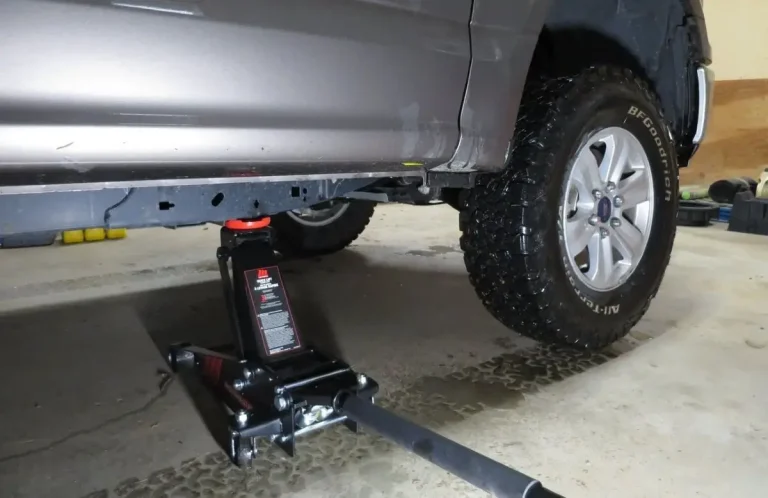
Will a Low Profile Jack Lift a Truck? The Short Answer: Yes, a low profile jack can lift the weight of a truck, but it will likely fail to lift the tire off the ground due to limited lift height. Most standard low profile jacks max out at 18–19 inches. Because trucks have significant suspension droop, you typically need 21–24 inches of lift at the frame rail to get the wheels airborne. Unless you have a “Long Reach” low profile jack, you will likely need extensions or a larger jack.
It’s Not About Tonnage, It’s About Geometry
Let’s clear the air immediately. If you have a 3-ton low profile jack, you have enough muscle to lift a Ford F-150, a Chevy Silverado, or even a heavy-duty diesel. A 6,000 lb truck usually puts less than 2,000 lbs on a single corner jacking point.
The problem isn’t the hydraulic muscle. It’s the Suspension Droop.
When you slide a jack under a Honda Civic, you only need to lift the unibody about three inches before the stiff, short-travel suspension runs out of room and drags the tire up with it.
Trucks are beasts of a different nature. They are designed for articulation. When you push the frame rail up, the heavy solid axle (or independent front suspension) hangs down, fighting gravity. The spring relaxes. The shock absorber extends to its absolute limit.
This “droop” eats up your jack’s travel. You might spend the first 6 inches of your jack’s movement just taking the slack out of the suspension. If your jack has a Maximum Saddle Height of 18.5 inches, and your truck’s frame sits 12 inches off the ground, you only have 6.5 inches of effective lift. If the suspension droops 7 inches, you are maxed out, and the tire is still touching the floor.
Keywords You Need to Know
To understand why your gear isn’t working, you have to speak the language of the chassis.
- Static Ground Clearance: The height of the frame rail before you even touch it. On a stock 4×4, this can be 10 to 14 inches.
- Hydraulic Throw: The effective range of motion of your jack’s lifting arm.
- Pinch Weld vs. Frame Rail: Unibody SUVs (like Explorers or Pilots) often lift from a lower pinch weld. Body-on-frame trucks lift from the main rail, which sits higher and requires more reach.
- GVWR (Gross Vehicle Weight Rating): This tells you the max weight, but remember, you are never lifting the entire GVWR at once unless you are Hulk Hogan.
Jack Type Comparison
Not all floor jacks are created equal. The market used to be split: you bought a small jack for cars or a big, heavy bottle jack for trucks.
Today, the lines are blurred. Use this table to figure out where your equipment stands.
Lift Range Comparison: Low Profile vs. Truck Jacks
| Jack Type | Min Entry Height | Max Lift Height | Best Application | Will it Lift a Stock F-150? |
|---|---|---|---|---|
| Racing / Ultra-Low | 2.5″ – 3.0″ | 14.0″ – 15.5″ | Lowered Tuners / Track Days | No. Hard fail. It won’t even reach the frame on some lifted trucks. |
| Standard Low Profile | 3.0″ – 3.5″ | 18.0″ – 19.5″ | Sedans, Crossovers, Small SUVs | Borderline. Might work on 2WD base models. Fails on 4x4s. |
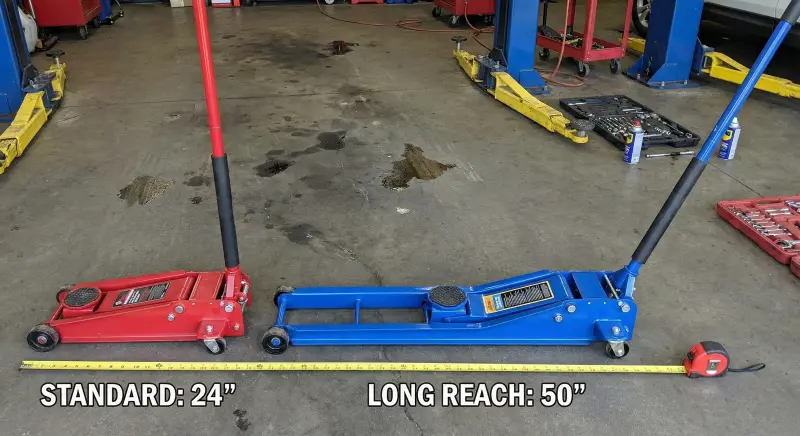
| Long Reach Low Profile | 3.25″ | 24.25″ | Mixed Garages (Cars & Trucks) | Yes. The “Goldilocks” solution. Reaches deep and lifts high. |
| Bottle Jack | 8.0″ – 9.0″ | 17″ + Screw Top | Roadside Emergency | Yes. Works because you lift the axle, not the frame. |
| Off-Road / Badland | 6.0″ | 29.0″ | Lifted Jeeps / Overlanding | Yes. But good luck fitting it under a lowered BMW. |
If you are looking at that table and realizing you own a “Standard Low Profile” jack, don’t panic yet. You might not need to buy a whole new $300 tool. But you definitely need to stop trying to force it to work by stacking questionable items on the saddle.
The “Hybrid” Solution: Long Reach Low Profile
The industry finally woke up about five years ago. They realized mechanics don’t want two massive jacks taking up floor space. Enter the Long Reach Floor Jack.
This is the only jack type I recommend for a general-purpose home garage. It features an elongated chassis and a lift arm with a different pivot point geometry. It gets down to 3.25 inches (low enough for your slammed Miata) but extends up to 24 inches.
That extra 5 to 6 inches of Maximum Saddle Height compared to a standard jack is the difference between changing a truck tire safely and cursing at a wheel that refuses to lift. If you are in the market to buy, skip the standard 3-ton and pay the extra $40 for the Long Reach. It pays for itself the first time you work on an SUV.
Improper Blocking
I have seen it a hundred times. A guy realizes his jack is too short. He looks around the garage. He sees a pile of cinder blocks in the corner.
Do not do it.
Cinder blocks are designed for static compression loads in construction, not the point-load stress of a steel jack wheel or saddle. They crumble without warning. When they fail, the truck falls, the jack shoots out sideways, and if you are lucky, you only lose a brake rotor. If you are unlucky, you lose a hand.
Safe Workarounds to Gain Height
If your current jack is an inch or two shy, you have safe options that don’t involve a death wish.
1. Universal Saddle Extensions
Many jacks allow you to remove the saddle pad. You can buy hard-mounted extensions that pin into the saddle hole, adding 3 to 5 inches of solid steel height. Make sure the extension is specific to your jack’s saddle pin diameter.
2. Cross Beam Adapters
This is a pro move. A Cross Beam Adapter replaces your jack’s saddle. It spreads the lift points to the frame rails on both sides of the front or rear end. Not only does this lift the entire axle at once (saving you time), but the beam itself sits on top of the jack arm, adding roughly 4 to 6 inches of stack height.
3. Proper Cribbing
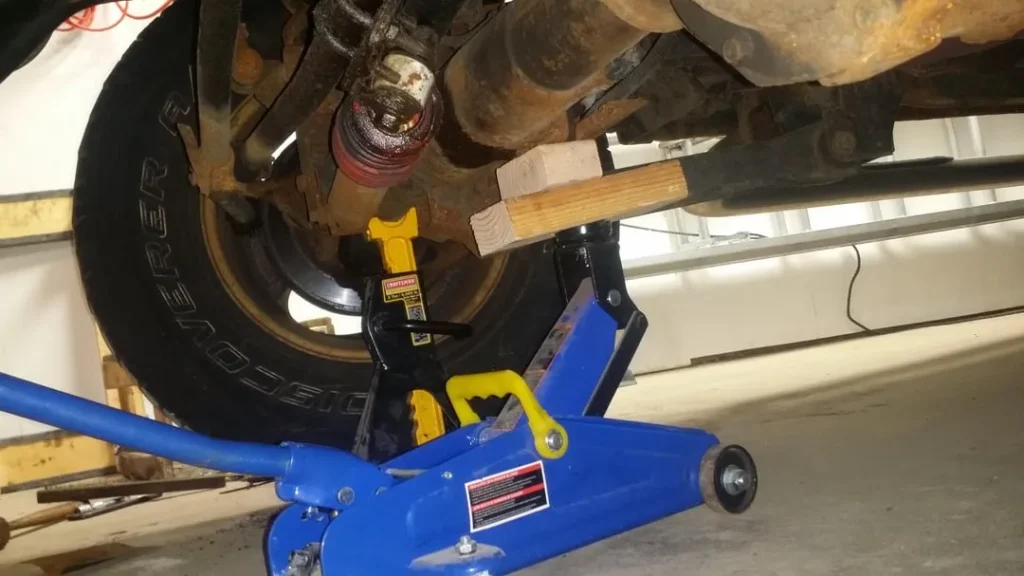
If you must use wood, build Cribbing. This isn’t a loose 2×4 balanced on the saddle.
- The Wrong Way: Putting a block of wood on top of the jack saddle. This is unstable; the wood can split or slip off the metal saddle teeth.
- The Right Way: Building a platform under the jack. Use 2×12 lumber, screwed together in a wide, flat platform. If you raise the ground the jack sits on, you gain lift height without compromising the stability of the saddle-to-frame contact point.
Measuring Before You Buy
Don’t guess. Suspension variables are too wild to estimate. Grab a tape measure and do this 2-minute check before you drop money on a new jack.
- Park on flat concrete.
- Measure from the ground to your truck’s frame lift point. Let’s say it’s 14 inches.
- Grab the fender well and lift up. See how much the truck moves before the tire starts to unweight. Alternatively, check a forum for your truck’s “suspension travel.” A safe bet for a stock 4×4 is 5 inches of droop.
- Add a safety margin of 2 inches for tire clearance (to get the wheel off the studs).
The Math: 14″ (Static) + 5″ (Droop) + 2″ (Clearance) = 21 inches.
If the box on the jack says “Max Height: 18.25 inches,” put it back on the shelf. It won’t work.
Troubleshooting: Why Is My Jack Not Lifting High Enough?
Sometimes, you have the right tool, but it’s acting like the wrong one. If your 3-ton jack stops lifting halfway up, you might have air in the system.
Hydraulic jacks work on fluid displacement. If an air bubble gets trapped in the main piston, the hydraulic fluid compresses the air instead of pushing the piston.
The Fix:
- Open the release valve (turn handle counter-clockwise).
- Pump the handle rapidly 10–15 times. This cycles the fluid and forces air out.
- Close the valve.
- Test lift.
- Check the oil fill plug. If the oil is low, the jack will run out of “throw” before it reaches max height. Top it off with high-quality hydraulic jack oil (never brake fluid).
FAQs
Can I lift my truck by the differential (pumpkin) to avoid suspension droop?
Technically, yes, on solid rear axles. This bypasses suspension droop entirely because you are lifting the axle directly. However, check your owner’s manual. Some stamped steel diff covers can bend under the weight, causing leaks. Always use a jack pad to protect the diff. Never lift by the front differential on independent suspension (IFS) trucks; the housing is usually aluminum and off-center.
Is a 2.5-ton jack enough for a Silverado 1500?
Yes, for lifting one corner. A Silverado 1500 weighs around 5,500 lbs. One corner is roughly 1,400 lbs. A 2.5-ton jack is rated for 5,000 lbs. The safety factor is there. The issue, again, will be height, not weight.
My jack lifts the truck, but it slowly sinks. Why?
This is a failure of the internal check valve or a worn piston seal. It is a major safety hazard. This is exactly why Jack Stands are non-negotiable. Never rely on the hydraulics to hold the load, especially if they are already showing signs of bypass.
Are “Off-Road” jacks safe for garage use?
The “High-Lift” style farm jacks are notoriously unstable. They are for getting unstuck in mud, not for changing oil in a garage. Use a floor jack on concrete. If you have a lifted truck with big tires, use a “Badland” style floor jack with large wheels, but keep the farm jack for the trail.
Can I use a bottle jack instead?
Yes. Bottle jacks have massive power and a high lift range relative to their size. The downside is stability. They have a tiny footprint. If the truck shifts, a bottle jack can tip over easily. They are great for roadside changes (lifting on the axle) but annoying for garage work where you want speed and stability.
Final Verdict
If you own a truck, stop fighting with equipment designed for a Honda.
The frustration of stacking wood, bleeding air, and maxing out hydraulic travel isn’t a badge of honor; it’s a waste of time. If you have the budget, the 3-Ton Long Reach Low Profile floor jack is the single most versatile tool you can put in your shop. It respects the physics of suspension droop while staying low enough to service the wife’s sedan.
Get the right tool. Measure your droop. And for the love of gears, stay away from the cinder blocks.